Keynote · Compute! Paris 2026
Saving
Conda
Wolf Vollprecht · prefix.dev
Hi, I’m Wolf.
- I started in open source at QuantStack
- I did the usual things: wrote a Python compiler, worked on xtensor …
- Today I’m CEO of prefix.dev. We build Pixi and rattler, and I mostly work on rattler-build
This might seem unrelated, but …
xtensor:
NumPy in C++
- More speed for scientific computing
- Write once, with bindings for Python, R and Julia
- The goal was to connect ecosystems
Jupyter: one ecosystem for all
- Widgets for Python, but also for R, Julia, C++ …
- Making scientific computing available to more people
So, what about Conda?
We ship xtensor
as Conda packages
“But I thought Conda is for Python?!”
- Conda is a general-purpose, cross-platform, language-agnostic package manager
- It works for Python, R, C++ and CUDA, but also for Fortran, OpenMP, OCaml, Zig, Rust …
Don’t reinvent
the wheel.
Find the people who already built one.
“Conda” means more than one thing
Why “save Conda”?
1conda
the package manager
2.conda
the package format
5conda-forge
the huge free and open source package distribution
Part one
Saving the
package manager
I wanted to build 3000 ROS packages for conda-forge
But all I could see was this:
Why was Conda so slow?!
$ conda install ros-noetic-desktop
Collecting package metadata: done
Solving environment: failed with initial frozen solve.
Retrying with flexible solve.
Solving environment: /… still solving · 0:00
So I replaced
the solver
- It turned out the SAT solver was slow as hell
- One weekend I set out to fix it, with our usual recipe: look at other ecosystems
- libsolv to the rescue, the SAT solver used by RPM
Lessons learned:
Reach out.
Just ask.
Where “mamba”
failed …
- At that point we could not convince Conda to integrate our solver
- So mamba was born, and later micromamba
- That led to years of confusion over which tool to use
Sometimes contributing to open source is hard.
Over time, good software wins
An enthusiastic community backed us, and filed issues.
conda-build →
conda mambabuild
- What I really wanted was to build packages
- For a while, shoe-horning mamba into conda-build was the only way for conda-forge to get acceptable build times
I am not proud of the code, but it worked, and it “saved” conda-forge.
Then we started over, in Rust
Pixi
$ pixi init my-project
$ pixi add python numpy
$ pixi run test
Lockfile by default
Project workspaces
Built-in tasks
Conda and PyPI packages
Global tools
Building from source
Two commands, and it runs
The lockfile is in the repo, so there is no install guide to follow.
That makes open source easier to use, to share and to contribute to.
$ git clone https://github.com/…/project
$ cd project
$ pixi run start
✔ environment installed from pixi.lock
✔ running task “start”Remember the spinner?
Part two
Saving the
governance
Conda is no longer under Anaconda’s control
Jannis Leidel worked hard on the governance and the move to NumFOCUS.
A multi-stakeholder steering council
- At most 2 seats per company
- It decides on CEPs, the Conda Enhancement Proposals
Making Conda vendor-neutral
… all perfectly supported by our tools.
OCI
We run a GHCR mirror of conda-forge and bioconda
so that no company can claim ownership.
Some exciting CEPs
CEP 13 · 14 · 39 · 40 · 41
The new recipe format
CEP 48
Repodata “v3”
CEP 27 · 50
Sigstore support
CEP 13 & 14
The new recipe format
meta.yaml
{% set version = "0.27.1" %}

package:
  name: xtensor
  version: {{ version }}

requirements:
  host:
    - python
    - numpy  # [not win]
→
recipe.yaml
context:
  version: "0.27.1"

package:
  name: xtensor
  version: ${{ version }}

requirements:
  host:
    - python
    - if: not win
      then: numpy
Pure YAML with a spec, built by rattler-build.
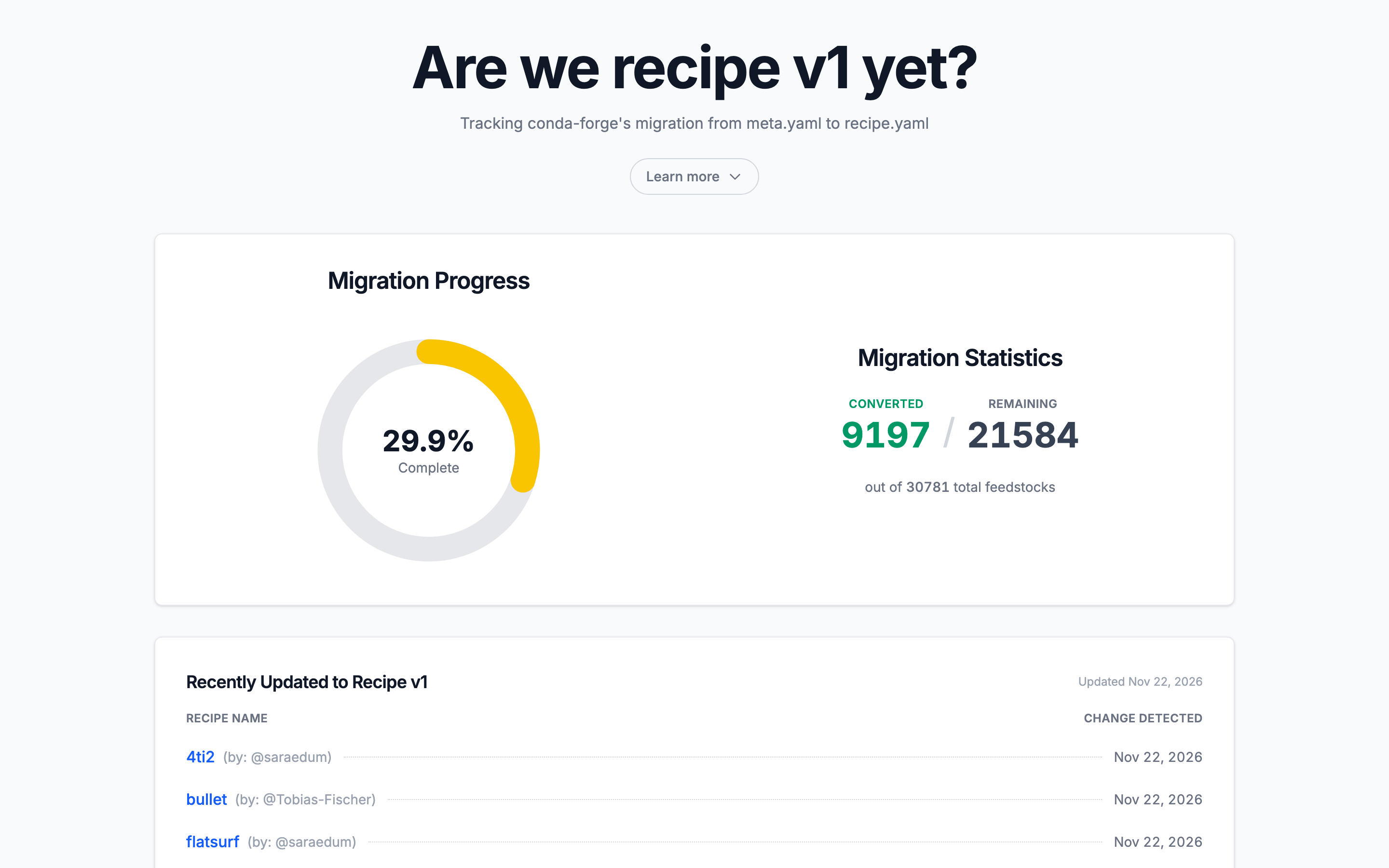
Tracking conda-forge’s migration from meta.yaml to recipe.yaml
Are we recipe v1 yet?
tdejager.github.io/are-we-recipe-v1-yet · 26 Nov 2026
CEP 48
Repodata “v3”
Every solver reads repodata, so a change can break old clients.
CEP 48 adds a new top-level key that old clients ignore.
{
  "info": { "repodata_revisions": { "v3": {…} } },
  "packages": {…},
  "packages.conda": {…},
  "v3": {…}
}
What it makes possible
CEP 43
Conditional
dependencies
CEP 44
Optional
dependency groups
CEP 45
Simplified
variant selection
Three big changes
CEP 43Conditional dependencies
One noarch package instead of one per Python and platform
run:
  - python
  - numpy>=2[when="python>=3.10"]
CEP 44Extras
No more -base and -with-… packages
extras:
  plot:
    - matplotlib-base >=3
# ask for it:  mypkg[extras="plot"]
CEP 45Flags
Pick a variant without globbing the build string
build:
  flags: ["cuda", "blas:mkl"]
# ask for it:  pytorch[flags=["cuda", "blas:*"]]
CEP 27 & CEP 50
Sigstore for
Conda packages
- Who built this package, and from which source?
- The attestation is published next to the package, as a
.sigs file
Build in CI
Sign with Sigstore
Publish next to the package
Clients fetch and verify
We are now also “saving” conda-forge, by securing it
Ecosystem security:
Basilisk & pixi audit
funded by STACVE mapping
Which CVE affects which conda package?
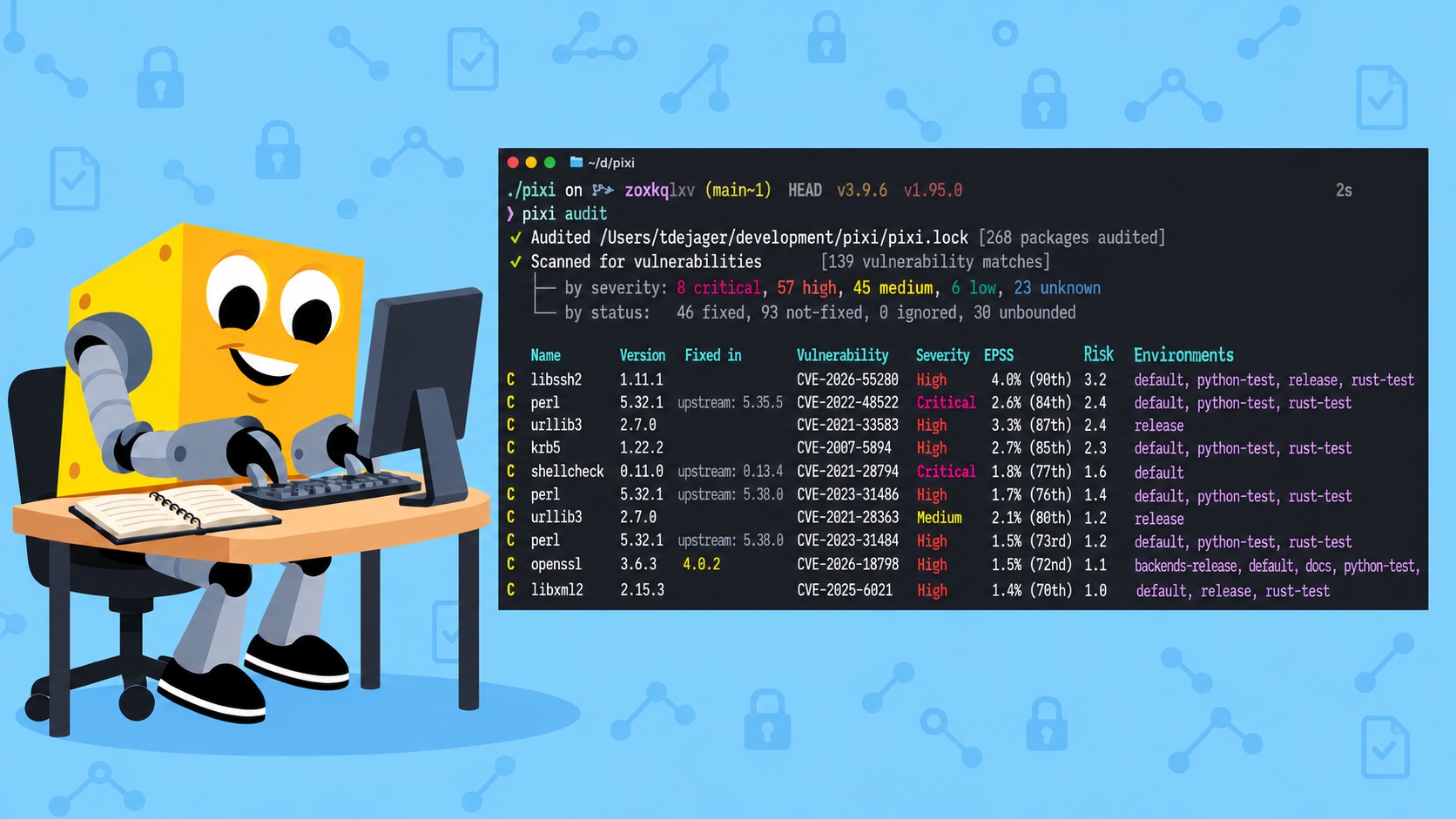
pixi audit
Check an environment for known vulnerabilities
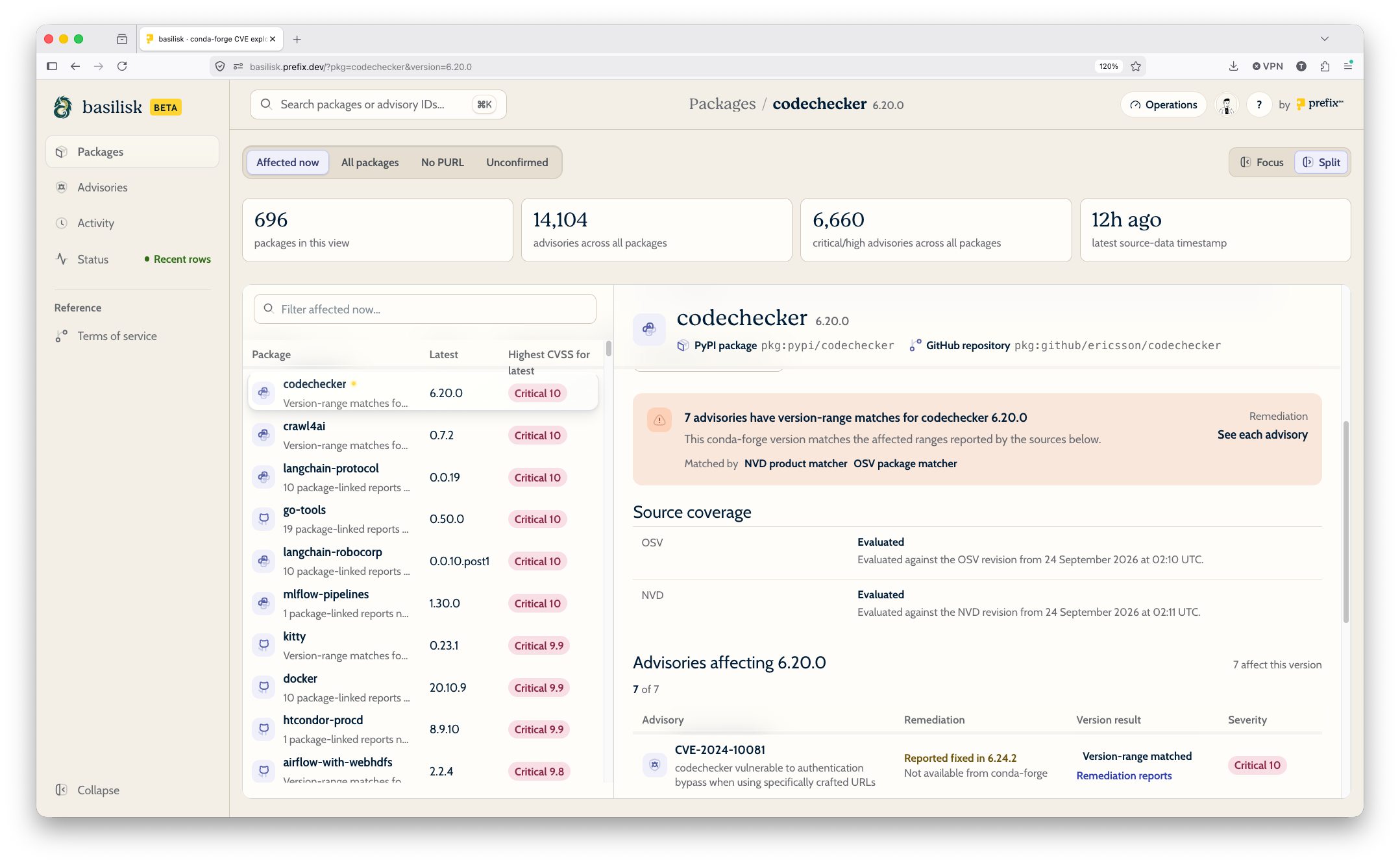
Basilisk
Track vulnerabilities across shipped releases
A vulnerability database for conda-forge
Basilisk
basilisk.prefix.dev
Like pip audit or npm audit, for conda-forge and PyPI packages
pixi audit
prefix.dev/blog/pixi-audit-beta
Part three
Where are
we now?
conda-forge downloads, October 2026
2.44B
+25.7% vs September
Is it agents, or is it Pixi?! :)
New ecosystems are blooming
ROS & RoboStackstronger than ever
after Claude Monet, Poppy Field (1873, Musée d’Orsay, Paris) · repainted in code
Reverse impact
New people are discovering the ecosystem, or coming back
“I found Rattler by chance, and replaced thousands of lines of bash nonsense with clean, declarative YAML.”
“Everything Just Worked, it was awesome. I had no idea Conda, and ya’ll, have sort of solved package management in a sense!”
— a developer who found rattler
“After bouncing off of conda many years ago, the tooling and ecosystem have made us return.”
— Oliver Lantwin, CERN
Conda is so versatile
Where can it
help next?
- More HPC
- More robotics
- Old and new language ecosystems: OCaml, Lisp, Mojo … Matlab?
A single, best-in-class solution
Last part
Communities
and AI
My journey was only possible because of humans
Sylvain
gave me a job and let me hack
Michael Schröder
implemented Conda support in libsolv
Filipe Fernandes
pushed me into conda-forge core
Uwe Korn
tested mamba and Pixi on the day they came out
… and many more.
But with AI,
do we still
need them?
Everyone can build their own package manager with AI.
The new recipe format and our tools make it very easy to build your own ecosystem.
Our advice: build on incredible shared foundations, with best-in-class tools.
For Pixi, we have introduced
Vouching
We want to know you.
inspired by Ghostty
Hard to decide between …
More contributors
exciting!
vs
AI slop
conda-forge is still undecided.
AI and package managers
Easier than ever to roll your own “factory”
Attackers also have an easier time
Registries and communities are targets with a high blast radius.
Defending might also need “AI” …
We build the foundational tooling for sharing the scientific software of the past, present and future.
Securely Enabled for agentic workflows …
Thank you — merci !
Come build
with us.
prefix.devpixi.shconda.orgconda-forge.org